Wat je moet weten voordat je
begint

Start 4 June 2026 19:48

Einde 4 June 2026

00 Dagen
00 Uren
00 Minuten
00 Seconden
course image

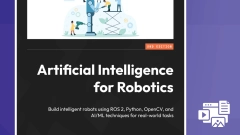
Artificial Intelligence for Robotics

Dive into AI-powered robotics using ROS 2, Python, and OpenCV to build intelligent robots with neural networks, computer vision, and natural language processing capabilities.
Packt via Coursera

Packt

2868 Cursussen


15 hours 49 minutes

Optionele upgrade beschikbaar

Not Specified

Ga in je eigen tempo vooruit

Paid Course

Optionele upgrade beschikbaar

Overzicht

This course dives deep into the integration of artificial intelligence and machine learning within robotics. You will learn to build intelligent robots capable of performing real-world tasks using ROS 2, Python, OpenCV, and advanced AI/ML techniques.

By focusing on neural networks, computer vision, and natural language processing, this course will help you enhance robot functionality for complex tasks. Throughout the course, you will improve your skills in applying AI and ML techniques, implementing object recognition systems, and navigating robots.

The content is designed for hands-on learning, allowing you to work on practical problems while developing a real-world understanding of intelligent robotics systems. What sets this course apart is its unique combination of theory and practical application.

The course integrates state-of-the-art AI/ML concepts into the design and development of robotics projects, equipping you with the tools to work on intelligent robot systems. The hands-on approach makes the theoretical knowledge more accessible and applicable in real-life scenarios.

This course is perfect for robotics engineers, AI/ML enthusiasts, and students with a background in Python and electronics. If you're looking to create smarter, more capable robots, this course will help you take your skills to the next level.

Lesprogramma

  • The Foundation of Robotics and Artificial Intelligence
  • In this section, we explore integrating AI into robotics, focusing on decision-making, learning, and autonomy. Key concepts include neural networks, reinforcement learning, and autonomous behavior design.
  • Setting Up Your Robot
  • In this section, we explore robot anatomy, subsumption architecture, and ROS 2 setup to enable practical robotic system development through structured hardware and software configuration.
  • Conceptualizing the Practical Robot Design Process
  • In this section, we explore systems engineering principles for robot design, focusing on use cases, storyboards, and hardware/software requirements to guide practical robotic task development.
  • Recognizing Objects Using Neural Networks and Supervised Learning
  • In this section, we explore using convolutional neural networks (CNNs) and YOLOv8 for object recognition, focusing on image processing, supervised learning, and real-world applications in robotics and AI.
  • Picking Up and Putting Away Toys Using Reinforcement Learning and Genetic Algorithms
  • In this section, we explore training robots using reinforcement learning and genetic algorithms. Key concepts include Q-learning for grasping and GA-based path planning for autonomous manipulation.
  • Teaching a Robot to Listen
  • In this section, we explore robot speech recognition using NLP, STT, and TTS, and implement command processing with Mycroft to enhance natural language understanding and response generation.
  • Teaching the Robot to Navigate and Avoid Stairs
  • In this section, we explore robot navigation strategies without SLAM, focusing on AI-driven obstacle avoidance and sensor-based movement for efficient task execution.
  • Putting Things Away
  • In this section, we explore AI decision-making tools like decision trees, path planning, and expert systems for robotics.
  • Giving the Robot an Artificial Personality
  • In this section, we explore simulating artificial personality in robots using finite state machines and AI. Key concepts include behavior modeling and emotion simulation for practical robotic applications.
  • Conclusions and Reflections
  • In this section, we examine when to stop in AI development, explore robotics career paths, and assess AI risks to support informed decision-making in real-world applications.
  • Appendix
  • In this section, we will explore the foundational elements of robot communication and system design.

Gegeven door

Packt - Course Instructors


Vakgebieden

Artificial Intelligence