What You Need to Know Before
You Start

Starts 5 June 2026 03:45

Ends 5 June 2026

00 Days
00 Hours
00 Minutes
00 Seconds
course image

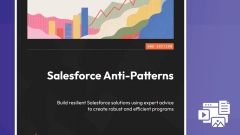
Salesforce Anti-Patterns

Discover common Salesforce development pitfalls and learn proven strategies to build scalable, maintainable enterprise applications while avoiding costly architectural mistakes.
Packt via Coursera

Packt

2868 Courses


13 hours 3 minutes

Optional upgrade avallable

Not Specified

Progress at your own speed

Paid Course

Optional upgrade avallable

Overview

Understanding Salesforce anti-patterns is essential for building scalable, maintainable, and secure enterprise applications on the Salesforce platform. This course provides professionals with the critical thinking skills needed to recognize architectural missteps before they become major obstacles.

Through a structured exploration of common pitfalls—from system architecture and security to data handling and integration—you’ll learn how to refine your development practices and prevent long-term issues. Each module offers practical guidance to improve performance, clarity, and sustainability of your Salesforce implementations.

What sets this course apart is its emphasis on real-world scenarios where theory meets practice. You’ll not only identify anti-patterns but also discover actionable strategies to resolve them, ensuring cleaner, more efficient development processes.

Ideal for Salesforce developers, architects, and admins with foundational platform experience, this course assumes familiarity with Salesforce's ecosystem and terminology but does not require advanced expertise. This course is based on material written by an expert author, bringing the depth of a book into a more engaging, interactive format.

The core content is delivered through clear, structured text you can read at your own pace, supported by short videos and quizzes to highlight key ideas and test your understanding. By combining the strengths of book learning with interactive assessments, you get the best of both worlds:

the depth and clarity of an author’s expertise, plus the flexibility to revisit, practice, and reinforce concepts whenever you need.

Syllabus

  • Why Do We Need to Understand Salesforce Anti-Patterns
  • In this section, we define prevalent Salesforce anti-patterns, trace their root causes, and apply a structured template, enabling architects to diagnose recurring design mistakes and craft resilient cloud solutions.
  • How to Keep Your System Architecture Clean
  • In this section, we detect Stovepipe, Big Ball of Mud, and tight coupling anti-patterns, gauge their scalability impact, and apply governance to limit Salesforce org sprawl, yielding maintainable architectures.
  • How Not to Get Confused About Security
  • In this section, we dissect common Salesforce security anti-patterns-misreading the shared responsibility model, equating compliance or declarative tools with protection, and resolving Spaghetti sharing architectures.
  • What Not to Do about Data
  • In this section we expose Salesforce data anti-patterns, from relational database assumptions to uncontrolled synchronizations and artificial intelligence misuse, then present governance and scalable modelling tactics.
  • Unpicking Solution Architecture Troubles
  • In this section, we diagnose Salesforce solution-selection anti-patterns, test assumption-driven designs, and apply governance-based refactoring to eliminate code smells, ensuring scalable, maintainable architectures.
  • Keeping Integration Straight
  • In this section, we identify Salesforce integration antipatterns, compare middleware, direct, and event-based patterns, and design lean, resilient interfaces that minimize chattiness and scale across complex system landscapes.
  • Keeping the Development Life Cycle from Going Off Track
  • In this section, we diagnose delivery anti-patterns like Big-Bang Release and infrequent check-in, then apply CI/CD pipelines, architecture-aligned packaging, and rigorous unit testing to sustain predictable, high-quality deployments.
  • Communication Without Mistranslation
  • In this section, we identify overcommunication and cognitive overload, enforce clarity to resolve ambiguity, adopt standard diagrams, and integrate systematic change management for reliable, comprehensible architectural decisions.
  • Conclusion
  • In this section, we uncover the root causes of architectural anti-patterns, refine solution design using that insight, and craft a continuous learning plan to deepen Salesforce and broader architecture skills.

Taught by

Packt - Course Instructors


Subjects

Business